
Standing water after every storm is one of the most common complaints on Baton Rouge-area lots. The ground is flat, the soil drains slowly, and the rain comes in heavy bursts. Two fixes come up again and again: a French drain and an underground downspout line. They sound similar, and both involve a trench and a pipe, but they solve different problems. Picking the wrong one is an expensive way to still have a puddle. Here is how they differ and how to tell which one your yard needs.
Why Baton Rouge lots hold water
NOAA's 1991–2020 normals put Baton Rouge Metro Airport at 61.94 inches of rain a year, with about 19 days a year of an inch or more. USDA soil survey data show that most mapped soils in East Baton Rouge Parish are somewhat poorly to very poorly drained, and the large majority fall in slow-infiltration hydrologic groups. The share of poorly drained soil is even higher in Ascension, Livingston and West Baton Rouge parishes. Slopes of 0–1% are the norm.
Put those together and water has nowhere to go quickly. A downspout that empties at the corner of the house can turn that corner into a pond. Much of the region's soil is also moderate-to-high shrink-swell clay, which expands when wet and shrinks when dry. See our post on clay soil, gutters and your foundation for more on that.
It also helps to know who handles what. According to the City-Parish 311 knowledge base, East Baton Rouge generally steps into neighbor runoff disputes only in limited cases, such as runoff from poor construction (handled through the permit process) or a structure blocking a dedicated drainage servitude. For most homeowners, water on your own lot is yours to manage. This is general information, not legal advice.
What is an underground downspout?
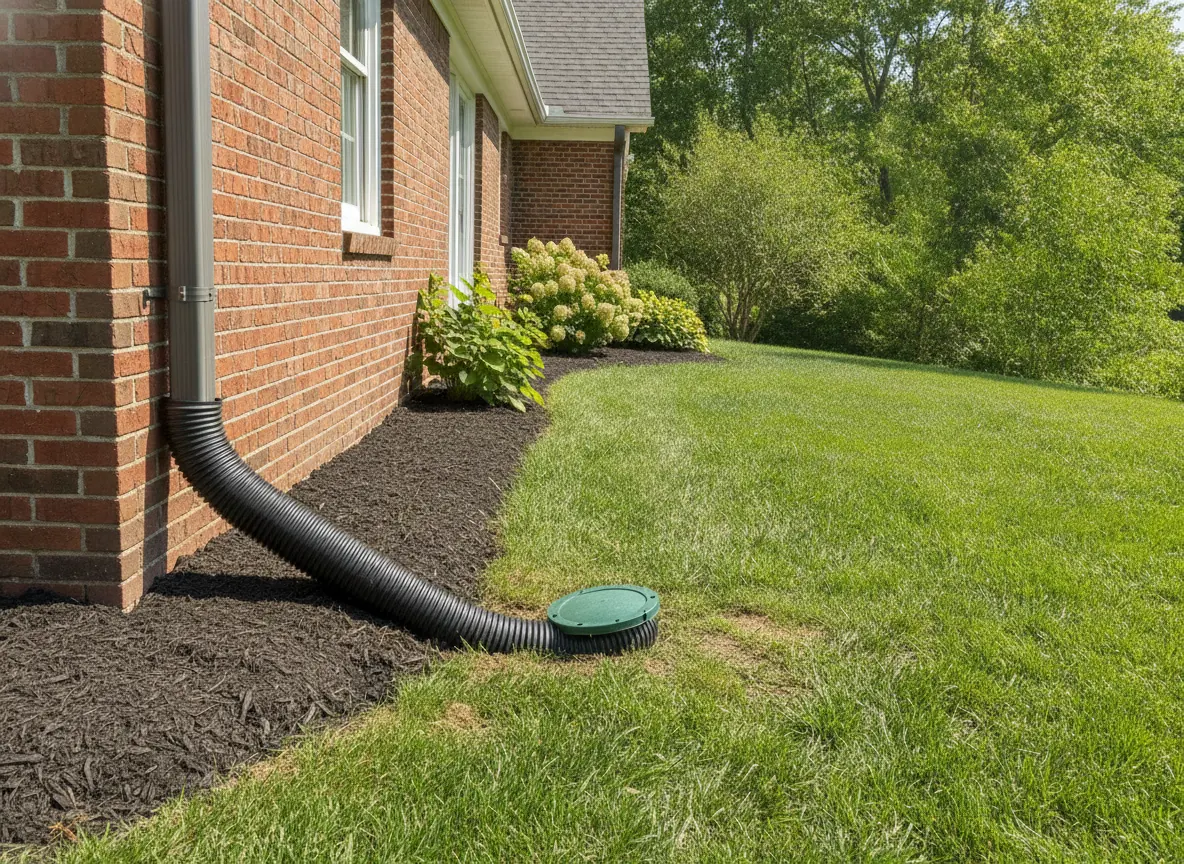
An underground downspout (sometimes called a buried downspout drain) connects the bottom of a downspout to a solid pipe buried in a shallow trench. The pipe carries roof water away from the house and lets it out somewhere it can drain or soak in, often at a pop-up emitter in the lawn, a curb outlet, a ditch or a dry well.
- What it fixes: roof water. Every inch of rain on your roof funnels into a few downspouts, so each one can dump a lot of water in one spot.
- How it works: solid (non-perforated) pipe, sloped downhill, from the downspout to the outlet.
- Where it shines: puddles and erosion right at the downspouts, splash-back on siding, and water near the slab after storms.
What is a French drain?
A French drain is a gravel-filled trench with a perforated pipe in it, usually wrapped in filter fabric. Water from the surrounding ground seeps into the gravel, enters the pipe through the holes, and flows to an outlet.
- What it fixes: groundwater and surface water across a yard, not just roof water.
- How it works: it collects water along its whole length and carries it away.
- Where it shines: soggy strips along a fence or slab, low spots that stay wet for days, and water flowing onto your lot from higher ground.
French drain vs underground downspout at a glance
| Underground downspout | French drain | |
|---|---|---|
| Water source | Roof, via gutters | Soil and surface water |
| Pipe | Solid | Perforated, in gravel |
| Good fit for | Pooling at downspouts | Wet strips and low areas |
| Typical length | Run from each downspout | Along the problem area |
| Typical cost | Depends on run length and outlet | About $10–$65 per ft (estimate) |
Should downspouts go into a French drain?
Usually not directly. A French drain is designed to soak up water slowly along its length. Sending a downspout's full flow into it during a heavy storm can overwhelm it, and roof grit and leaves can clog the gravel and fabric over time. Many installers prefer to run downspouts through their own solid pipe, either to a separate outlet or into the solid section of a combined system past the perforated part. If someone proposes connecting downspouts straight into a French drain, ask how they will keep debris out and where that much water will go.
Where does a French drain empty?
It is one of the most common drainage questions, and the honest answer is: somewhere lower. Water only flows downhill, and on a nearly flat lot finding enough fall is the hard part. Common outlets include:
- A low point in the yard with a pop-up emitter or open outlet.
- A roadside ditch or curb outlet, where allowed.
- A dry well or catch basin where the soil allows some infiltration.
- A sump that pumps water out, on lots with no usable natural fall.
Tying into a street, ditch, drainage servitude or other public right-of-way may involve parish rules. Check with your parish before work starts, and ask the installer how they plan to handle it. In East Baton Rouge, the City-Parish takes drainage service requests through 311.
Which one does your yard need?
- Puddles form right below downspouts and nowhere else: start with underground downspouts, or at least longer extensions.
- The yard stays soggy in a band or low spot long after rain: a French drain is more likely to help.
- Water sits against the slab on several sides: often both, plus a look at whether gutters are overflowing. Undersized gutters can mimic a drainage problem. See 5-inch vs 6-inch gutters.
- Water floods in from a neighbor or the street: a French drain or swale may manage some of it, but larger flooding is a parish-scale drainage issue, not a gutter fix.
One important note on scale: the region's worst floods, such as August 2016, were river and backwater flooding from extreme rainfall. No French drain or downspout line would have prevented that. These systems are for everyday storm runoff on your lot.
What do they cost?
Typical ranges from cost guides are estimates, not quotes, and the sources disagree:
- French drain: about $10–$65 per foot, or roughly $1,000–$6,500 for 100 feet (LawnStarter, 2026).
- Aluminum downspouts: about $9–$12 per foot.
Underground downspout pricing depends heavily on how many downspouts, how far each run goes and what kind of outlet is needed, so it needs to be priced on site. Trench length, depth, obstacles like tree roots and driveways, and whether a pump is needed all move the number. See the gutter installation cost page for the full table.
Questions to ask an installer
- Where exactly will the water exit, and how much fall does the run have?
- Solid or perforated pipe, and why?
- Will downspouts tie into the French drain, or run separately?
- How will debris be kept out, and is there a cleanout?
- Do you need to check anything with the parish before tying into a ditch or street?
Get a drainage quote
We connect Baton Rouge-area homeowners with independent local gutter and drainage installers for free, no-obligation quotes. An installer can walk the lot, watch where the water goes and suggest underground downspouts, a French drain or both. Learn more on our downspouts and drainage page or request a free quote.