Downspouts & Drainage in Baton Rouge, LA

Gutters collect the water. Downspouts and drainage decide where it ends up. We connect Baton Rouge-area homeowners with independent local gutter installers for free, no-obligation quotes on oversized downspouts, underground lines, pop-up emitters and French drains.

Get a Free Quote Call (727) 300-6656
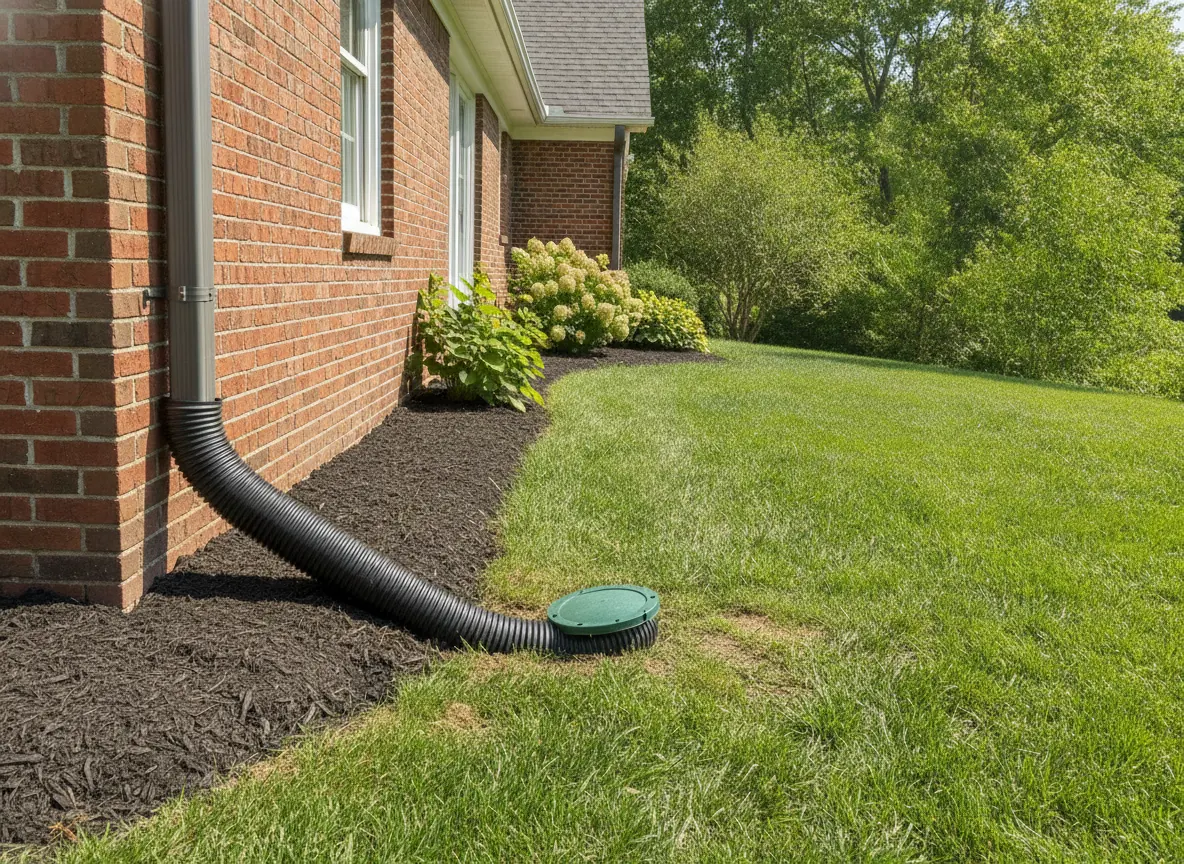
Downspout connected to an underground drain line with a pop-up emitter in the lawn

Why drainage matters on Baton Rouge lots

A 2,000-square-foot roof sheds a lot of water in a one-inch rain, and NOAA’s 1991–2020 normals show Baton Rouge Metro Airport averaging about 19 days a year with an inch or more. All of that water leaves the roof through a handful of downspouts.

Where it goes next depends on the ground. USDA soil survey data for the four Capital Region parishes show mostly flat land, with slopes of 0–1% dominating, and soils that are largely somewhat poorly to very poorly drained: roughly 80% of rated soils in East Baton Rouge and nearly all of Ascension. Water that pours out at the corner of the house has nowhere to run and little chance to soak in, so it ponds against the slab.

Clay soil and your foundation

Much of the metro also sits on clay that swells when wet and shrinks when dry. The same USDA data show a moderate-to-high shrink-swell rating for most soils in all four parishes, with the highest shares of high shrink-swell clay in West Baton Rouge, Ascension and Livingston parishes, home to Port Allen, Prairieville, Gonzales, Denham Springs and Walker. A 2021 LSU and Eustis Engineering study named Baton Rouge among the southern cities with the largest estimated losses from expansive soils, which heave when moisture is added.

Because this clay moves with moisture, dumping roof water at one corner of the house while another corner stays dry is worth avoiding. Spreading that water away from the slab is one of the few drainage steps a homeowner fully controls. Read more in clay soil, gutters and your foundation.

One note on 2016: the August flood was river and backwater flooding from extreme rain, with 11.24 inches at the airport on August 12 alone. Gutters and yard drains do not prevent that kind of flooding. Their job is everyday rain.

Drainage options installers quote

Oversized 3x4 downspouts

A 3x4-inch downspout moves water out of the gutter faster than a standard 2x3 and clogs less easily. It is the usual partner for 6-inch gutters, and adding downspouts to long runs can stop overflow. See seamless gutter installation for sizing.

Extensions and splash blocks

The simplest fix: carry water several feet from the wall before it lands. Cheap and effective, but extensions get kicked, mowed over and moved, and on a flat lot the water may still pool.

Underground downspout lines

A solid pipe buried from the downspout to an outlet away from the house, so water travels out of sight. On flat ground, holding a steady slope over a long run is the main challenge.

Pop-up emitters

A cap at the end of an underground line that pops open when water pushes up and drops closed when the flow stops. It lets water spread out at a lower spot in the yard and keeps critters and debris out of the pipe.

French drains

A perforated pipe in a gravel-filled trench, often wrapped in fabric, that collects water already standing in the soil or on the surface and carries it to an outlet. Useful for soggy side yards and low spots, not a substitute for a downspout line.

Combining systems

Many lots need downspout lines for roof water and a French drain for ground water. Installers often keep the two separate so a heavy roof flow does not back up into the French drain.

For a side-by-side comparison, read French drain vs underground downspout.

Where the water goes, and who is responsible

Every drain needs an outlet lower than its inlet. On a flat Baton Rouge lot, that might be a pop-up emitter at the low side of the yard, a dry well, or a ditch or street. Before any line ties into a street, ditch or public drainage, check with your parish; East Baton Rouge, Livingston, Ascension and West Baton Rouge each have their own offices and rules.

Also think about your neighbors. The City-Parish 311 knowledge base says it steps into neighbor runoff disputes only in narrow cases, such as poor construction handled through the building permit process or a structure blocking a dedicated drainage servitude. In practice, homeowners are expected to manage drainage on their own lot. For public ditch or drain problems in East Baton Rouge, the City-Parish takes requests through 311.

Typical downspout and drainage costs

Typical ranges from cost guides, 2023–2026 — estimates, not quotes.

ItemTypical range
Downspoutsaluminum $9–$12 per ft
French drain$10–$65 per ft (100 ft: $1,000–$6,500)
Seamless aluminum gutters, Baton Rouge (HomeBlue, 2025)$5.90–$10.30 per linear ft installed
Two-story add-on+$1–$3 per ft

The sources disagree, and drainage prices vary more than gutter prices because every lot is different. Your quote depends on footage, stories, material, downspout count, trench length and depth, and where the water can go. See the gutter installation cost guide.

Before you hire: Gutters plus underground drains on a large home can reach about $7,500, where Louisiana’s contractor board (LSLBC) says home improvement registration applies (up to $50,000; a residential license at $50,000 or more, per Act 178 of 2024). Registration requires liability insurance and workers’ comp, and the minimum liability coverage rose to $500,000 in 2026 (Act 757). Check the company on LSLBC’s contractor search, ask for a current insurance certificate and get a written contract that names each outlet. This is general information, not legal advice.

Downspout and drainage FAQ

Where does a French drain empty?

A French drain has to end somewhere lower than where it starts: often a pop-up emitter in a lower part of the yard, a dry well, or a ditch or street drain. On flat Baton Rouge lots, finding enough fall is the hard part. Tying into a street, ditch or public drainage may involve parish rules, so check with your parish before that work is planned.

What is the difference between a French drain and an underground downspout?

An underground downspout line is a solid pipe that carries roof water from a downspout to an outlet away from the house. A French drain is a perforated pipe in a gravel trench that collects water already in the soil or on the surface. Many soggy yards need one or the other; some need both, connected to separate outlets.

How much does a French drain cost?

A 2026 cost guide (LawnStarter) puts exterior French drains at about $10–$65 per foot, or roughly $1,000–$6,500 for 100 feet. That is a wide range because trench depth, pipe, gravel, fabric, outlets and access all change the price. These are estimates, not quotes; your price comes from an installer who has walked the lot.

Why does water pond near my foundation?

Across the Baton Rouge metro, USDA soil survey data show mostly flat, slow-draining soils, so water dumped at the base of a downspout tends to sit. Short or missing extensions, clogged gutters, soil sloping toward the house and undersized downspouts all make it worse. Moving roof water several feet away, or underground to a lower outlet, is often the first fix to price.

Do underground downspout lines clog?

They can. Leaves, shingle grit and roots can build up, especially where the pipe has low spots or no cleanout. Gutter guards upstream, smooth-wall pipe, steady slope and a cleanout near the downspout all help. Ask installers what pipe they use, how they keep a steady slope on a flat lot, and how the line can be flushed later.

Ready for gutters that handle Baton Rouge rain?

Free, no-pressure quotes across Baton Rouge, Central, Zachary, Denham Springs, Prairieville and nearby.

Call NowFree Quote